| Command Summary | Command Syntax | Calculator Compatibility | Token Size |
|---|---|---|---|
| Tests if two values are equal. | value1=value 2 | This command works on all calculators. | 1 byte |
Menu Location
Press the [=] key to enter =.
The = Command
The = operator compares two values, returning true if they're equal, and false otherwise. It is a basic building block of the conditions used by commands such as 68k:If, 68k:when(), and 68k:While. The results of = and the other relational operators (≠, >, ≥, <, and ≤) can be combined with the 68k:and, 68k:or, 68k:xor, and 68k:not operators to create more complicated conditions.
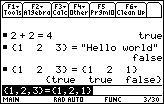
It returns a single value for most types of data, and returns false if the two sides are mismatched in type: comparing a single number to a list, for instance, or comparing two lists that are of a different size. The only exception is when comparing two 68k:lists or two 68k:matrices of the same size: in that case, it compares them element-by-element, and returns a list or matrix of true/false values.
:2+2=4
           true
:2+2=5
           false
:{1,2,3}={1,4,3}
           {true  false  true}
If either side or both contains undefined variables, = will wait to return a value unless it's something clearly true for any value of the variable (for instance, x=x). You can do math with the resulting equation (most operations will be applied to both sides), and extract the two halves of it with 68k:left() and 68k:right().
Optimization
Testing "If x=true" is redundant in most cases; you can shorten that to "If x". Similarly, "If x=false" can be "If not x".