| Command Summary | Command Syntax | Calculator Compatibility | Token Size |
|---|---|---|---|
| Returns a list filled with zeroes. | newList(length) | This command works on all calculators. | 1 byte |
Menu Location
N/A
The newList() Command
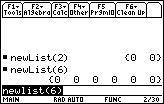
The newList() command returns a list of a specific length that is filled entirely with zeroes.
:newList(3)
           {0  0  0}
:newList(5)
           {0  0  0  0  0}
:newList(0)
           {}
This can be easily expanded to returning a list filled with any value: to return a list filled with a value x, just add x to the result of newList(). This works for strings as well, since "Hello"+0 simplifies to "Hello".
Advanced Uses
newList() can be used for making a comparison between a single value and a list. Normally, something like {1,2,3,4}=2 simply returns "false", since 2 is not a list and {1,2,3,4} is. To do a comparison element-by-element, use newList() to turn the single value into a list: in this case, 2+newList(4). Comparing {1,2,3,4} to 2+newList(4) will return {false, true, false, false} (you might use 68k:when() to get a single value out of this list).
This works to extend other operations to a number and a list, as well, though comparisons are the most useful application of this technique, since most operations already work this way.
Optimization
In many cases, an expression with newList() can be used to optimize a 68k:seq() command. First, observe that the simple
:seq(k,k,1,n)
which will return the list {1,2,3,...,n}, can be replaced by
:cumSum(1+newList(n))
The result is about twice as fast.
This is useful because many seq() expressions can be expressed using something like seq(k,k,1,n). For example:
:seq(k^2,k,1,n)

can be

:seq(k,k,1,n)^2

which is

:cumSum(1+newList(n))^2
This rearrangement is not always possible, but when it is, it gives a significant improvement in speed, with no real difference in size.
Here is a more complicated example (which is a sequence of probabilities with the binomial distribution). Notice the use of the 68k:with operator.
:seq(nCr(n,k) p^k (1-p)^(n-k),k,1,n)

can be

:nCr(n,a) p^a (1-p)^(n-a)|a=cumSum(1+newList(n))
Error Conditions
260 - Domain error happens when the length is not an integer ≥0.