| Command Summary | Command Syntax | Calculator Compatibility | Token Size |
|---|---|---|---|
| Calculates the approximate numerical derivative of a function, at a point. | nDeriv(f(variable),variable,value[,h]) | TI-83/84/+/SE | 1 byte |
Menu Location
Press:
1. MATH to access the math menu.
2. 8 to select nDeriv(, or use arrows.
The nDeriv( Command
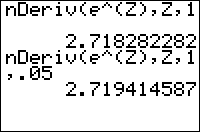
nDeriv(f(var),var,value[,h]) computes an approximation to the value of the derivative of f(var) with respect to var at var=value. h is the step size used in the approximation of the derivative. The default value of h is 0.001.
nDeriv( only works for real numbers and expressions. nDeriv( can be used only once inside another instance of nDeriv(.
π→X
     3.141592654
nDeriv(sin(T),T,X)
     -.9999998333
nDeriv(sin(T),T,X,(abs(X)+E⁻6)E⁻6)
     -1.000000015
nDeriv(nDeriv(cos(U),U,T),T,X)
     .999999665
Advanced
If the default setting for h doesn't produce a good enough result, it can be difficult to choose a correct substitute. Although larger values of h naturally produce a larger margin of error, it's not always helpful to make h very small. If the difference between f(x+h) and f(x-h) is much smaller than the actual values of f(x+h) or f(x-h), then it will only be recorded in the last few significant digits, and therefore be imprecise.
A suitable compromise is to choose a tolerance h that's based on X. As suggested here, (abs(X)+]E⁻6)E⁻6 is a reasonably good value that often gives better results than the default.
Formula
The exact formula that the calculator uses to evaluate this function is:
This formula is known as the symmetric derivative, and using it generally increases the accuracy of the calculation. However, in a few instances it can give erroneous answers. One case where it gives false answers is with the function,
This derivative is undefined when calculated algebraically, but due to the method of calculation, the derivative given by nDeriv( is zero. These problems can be avoided by ensuring that a function's derivative is defined at the point of interest.
Error Conditions
- ERR:DOMAIN is thrown if h is 0 (since this would yield division by 0 in the formula)
- ERR:ILLEGAL NEST is thrown if
nDeriv(commands are nested more than one level deep. Just having onenDeriv(command inside another is okay, though.