| Command Summary | Command Syntax | Calculator Compatibility | Token Size |
|---|---|---|---|
| Puts a matrix into row-echelon form. | ref(matrix) | TI-83/84/+/SE | 2 bytes |
Menu Location
Press:
1. MATRX (on the TI-83) or 2nd MATRX (TI-83+ or higher) to access the matrix menu.
2. RIGHT to access the MATH submenu.
3. ALPHA A to select ref(, or use arrows.
The ref( Command
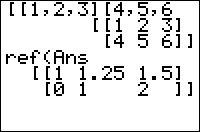
Given a matrix with at least as many columns as it has rows, the ref( command uses a technique called Gaussian elimination to put the matrix into row-echelon form.
This means that the leftmost N columns (if the matrix has N rows) of the matrix are upper triangular - all entries below the main diagonal are zero. What's more, every entry on the main diagonal is either 0 or 1.
[[1,2,5,0][2,2,1,2][3,4,6,2]]
    [[1 2 5 0]
     [2 2 1 2]
     [3 4 6 2]
ref(Ans)►Frac
    [[1 4/3 2   2/3]
     [0 1   9/2 -1 ]
     [0 0   0   0  ]]
Advanced Uses
In theory, a system of linear equations in N variables can be solved using the ref( command - an equation of the form \(a_1x_1+\dots + a_nx_n = b\) becomes a row \(a_1, \dots, a_n, b\), and is put into the matrix. If there is a sufficient number of conditions, the last row of the reduced matrix will give you the value of the last variable, and back-substitution will give you the others.
In practice, it's easier to use rref( instead for the same purpose.
Error Conditions
- ERR:INVALID DIM is thrown if the matrix has more rows than columns.