| Command Summary | Command Syntax | Calculator Compatibility | Token Size |
|---|---|---|---|
| Gives the ASCII code of a character. | ord(string) | This command works on all calculators. | 2 bytes |
Menu Location
- Press 2nd MATH to enter the MATH popup menu.
- Press D to enter the string submenu.
- Press B to select ord(.
The ord() Command
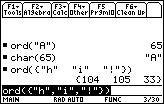
The ord() command gives the ASCII code of a character (that is, its character code, which is a modification of standard ASCII). The input is meant to be a single character, but the command doesn't actually check for that — so in practice, it gives the ASCII code of the first character in a string. You can convert multiple characters at once by giving ord() a list (or matrix) of characters.
The inverse of ord() is 68k:char(), which converts a character code to a character.
:ord("America")
           65
:ord({"A","b","c"})
           {65  98  99}
:ord("")
           0
Optimization
Code such as
:inString("ABCDEFGHIJKLMNOPQRSTUVWXYZ",str)
should be replaced by appropriate use of ord(); in this case,
:ord(str)-64
Related Commands
See Also
Authors: