| Command Summary | Command Syntax | Calculator Compatibility | Token Size |
|---|---|---|---|
| Multiplies together the evaluations of an expression with one variable taking on a range of values. | ∏(expression, variable, start, end) | This command works on all calculators. | 2 bytes |
Menu Location
- Press 2nd MATH to enter the MATH popup menu.
- Press B to enter the Calculus submenu.
- Press 5 to select ∏(.
The ∏() Command
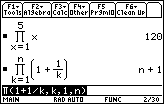
∏() is used to multiply a sequence of numbers. ∏(expression, variable, start, end) will evaluate expression for variable=start, then for variable=start+1, all the way through variable=end, and multiply the results:
:∏(f(x),x,1,5)
           f(1)*f(2)*f(3)*f(4)*f(5)
:∏(x,x,1,5)
           120
In this way, ∏() is no different from taking 68k:product() of a sequence generated by 68k:seq(). However, ∏() can be used for more abstract calculations — for instance, when start or end is an undefined variable, it will try to find the product in terms of that variable. ∏() can also be used to find the product of an infinite series (just make the value of end infinity — ∞).
:∏(x,x,1,n)
           n!
:∏(1-1/x,x,2,n)
           1/n
Related Commands
Authors: