| Command Summary | Command Syntax | Calculator Compatibility | Token Size |
|---|---|---|---|
| Generates a random integer between min and max, inclusive, or a list of such numbers. | randInt(min,max[,# of numbers]) | TI-83/84/+/SE | 2 bytes |
Menu Location
Press:
1. MATH to access the math menu.
2. LEFT to access the PRB submenu.
3. 5 to select randInt(, or use arrows.
The randInt( Command
randInt(min,max) generates a uniformly-distributed pseudorandom integer between min and max inclusive. randInt(min,max,n) generates a list of n uniformly-distributed pseudorandom integers between min and max.
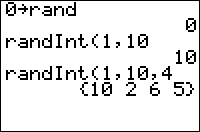
seed→rand affects the output of randInt(.
0→rand
     0
randInt(1,10)
     10
randInt(1,10,5)
     {10 2 6 5 8}
Optimization
When the lower bound of randInt( is 0, you can replace it with int(#rand to save space. For example:
:randInt(0,12
can be
:int(13rand
Similarly, if you don't want to include zero in the range, you can use a variant of 1-#int(#rand:
:1-2int(2rand
In this particular example, the only values that you will ever get are -1 or 1.
Formulas
The value of randInt( for a given seed can be expressed in terms of rand:
randInt(A,B)=
- when A<B, A+int((B-A+1)rand
- otherwise, B+int((A-B+1)rand
This is identical to the output of randInt( in the sense that for the same seed, both expressions will generate the same random numbers.
Error Conditions
- ERR:DOMAIN is thrown if any of the arguments is a decimal.
- ERR: DATA TYPE is given if you use imaginary numbers like 6i or something like Matrices or Lists. This error is used instead of ERR:DOMAIN for "i".